
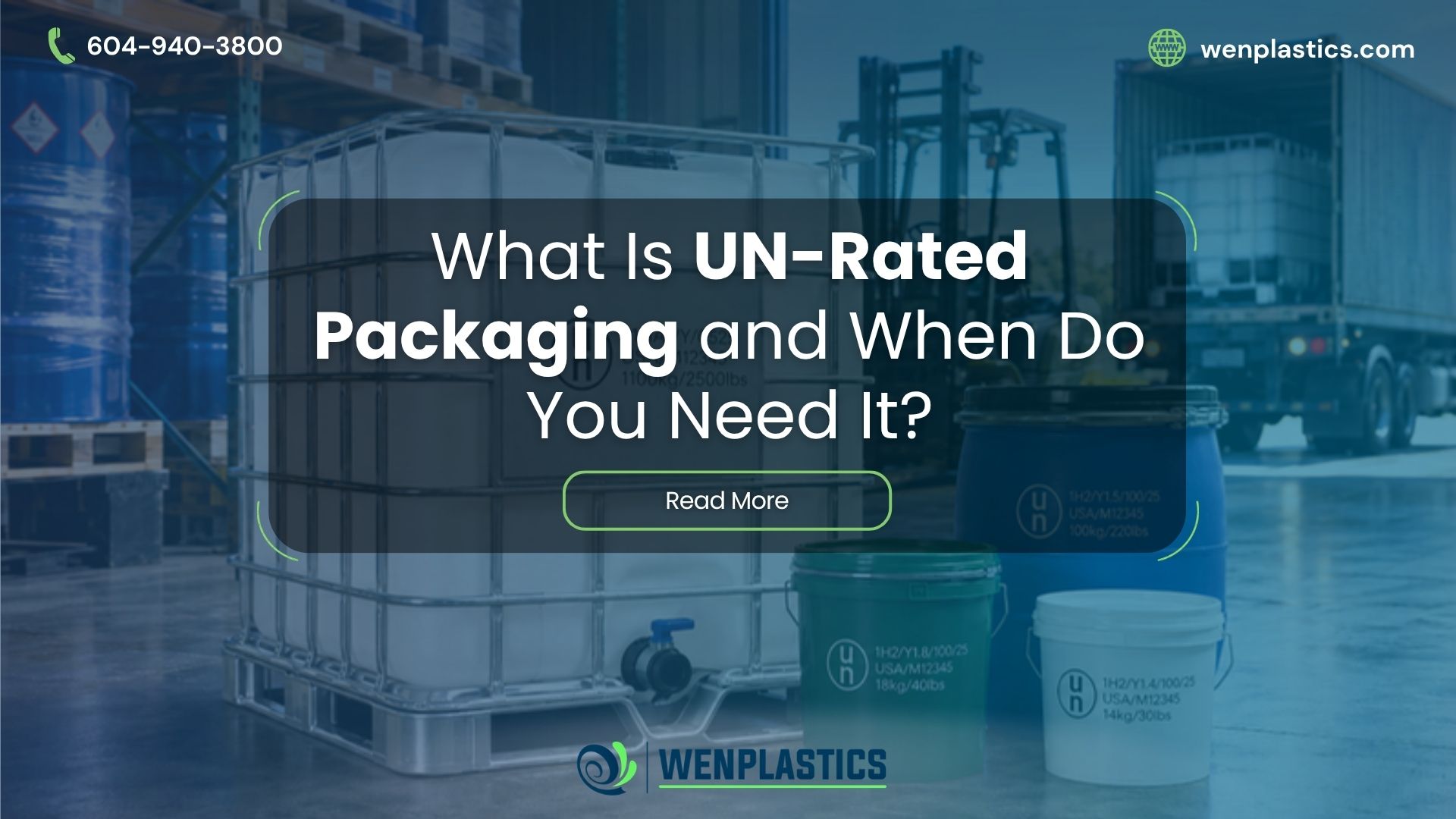
What Is UN-Rated Packaging and When Do You Need It?
When businesses store, handle, or transport certain chemicals and regulated products, choosing the right packaging is not only a matter of convenience. It is also a matter of safety, compliance, and product protection.
This is where UN-rated packaging becomes important.
UN-rated packaging is designed and tested for the transportation of certain dangerous goods. It helps ensure that products are contained safely during handling, storage, and transportation, reducing the risk of leaks, spills, damage, and exposure.
For companies that work with chemicals, industrial liquids, cleaning products, coatings, adhesives, fertilizers, or other regulated materials, understanding when UN-rated packaging is needed can help prevent costly mistakes and support safer operations.
What Does UN-Rated Packaging Mean?
UN-rated packaging refers to packaging that has been designed, tested, and marked according to specific standards for the transportation of dangerous goods.
The “UN” marking shows that the packaging meets performance requirements for certain types of regulated products. These requirements may involve tests related to strength, stacking, leak prevention, pressure, drop resistance, and overall packaging performance during transport.
UN-rated packaging can include different types of containers, such as:
- Plastic pails
- Plastic drums
- Steel drums
- IBC totes
- Jerricans
- Boxes
- Combination packaging
For Wenplastics customers, the most relevant examples are often UN-rated IBC totes and UN-rated plastic pails, which are commonly used for chemicals, industrial products, and other regulated materials.
Why UN-Rated Packaging Matters
Not every product can be shipped in standard packaging. Some products may present risks during transportation, such as flammability, toxicity, corrosiveness, environmental hazards, or other safety concerns.
If a product is classified as a dangerous good, it may require packaging that meets specific regulatory requirements. Using the wrong packaging can lead to safety risks, shipment delays, rejected loads, product loss, penalties, or liability issues.
UN-rated packaging helps businesses by providing packaging that has been tested for specific performance standards. It supports safer transport and helps ensure that the packaging is appropriate for the product being shipped.
When Do You Need UN-Rated Packaging?
You may need UN-rated packaging when your product is classified as a dangerous good for transportation.
This can include products such as:
- Certain chemicals
- Solvents
- Flammable liquids
- Corrosive products
- Industrial cleaners
- Paints and coatings
- Adhesives
- Fertilizers
- Automotive fluids
- Some waste materials
- Certain agricultural and manufacturing products
The need for UN-rated packaging depends on the product classification, packing group, mode of transport, destination, and applicable regulations.
For this reason, businesses should always review the product’s Safety Data Sheet, transportation classification, and regulatory requirements before choosing packaging.
UN-Rated Does Not Mean Every Product Requires It
One common misunderstanding is that UN-rated packaging is always better or always required. This is not necessarily true.
UN-rated packaging is designed for specific regulated products and transport conditions. If your product is not classified as a dangerous good, standard industrial packaging may be suitable.
For example, a company storing non-regulated liquids, water-based products, or general industrial materials may not need UN-rated packaging. In these cases, a standard IBC tote, plastic drum, or plastic pail may be enough, depending on the product and application.
The key is not simply choosing the strongest packaging. The key is choosing the right packaging for the product and use case.
UN-Rated vs. Food-Grade Packaging
Another common confusion is the difference between UN-rated and food-grade packaging.
These terms do not mean the same thing.
UN-rated packaging is related to the safe transportation of certain dangerous goods.
Food-grade packaging is related to whether the packaging material is suitable for contact with food products.
A container can be food-grade without being UN-rated. A container can also be UN-rated without being suitable for food contact. In some cases, a business may need packaging that meets both requirements, depending on the product.
For example, a food ingredient producer may need food-grade packaging, but not UN-rated packaging. A chemical manufacturer may need UN-rated packaging, but not food-grade packaging.
Before choosing a tote or pail, businesses should confirm what requirements apply to their specific product.
Understanding Packing Groups
Many dangerous goods are assigned to a packing group based on the level of danger they present.
In general:
- Packing Group I represents higher danger
- Packing Group II represents medium danger
- Packing Group III represents lower danger
The packing group helps determine what type of packaging may be required. A product with a higher level of danger may require packaging that meets more demanding performance standards.
This is why businesses should not choose UN-rated packaging based only on size or price. The product classification and packing group are essential to selecting the correct packaging.
What Do UN Markings Mean?
UN-rated packaging includes markings that provide important information about the packaging type and performance level.
The exact marking depends on the container type, but it may include details such as:
- Packaging type
- Material
- Packing group performance level
- Year of manufacture
- Country of approval
- Manufacturer or certification information
- Maximum gross mass or specific gravity
- Test pressure, when applicable
For IBC totes, markings may also indicate the IBC type and construction. For example, composite IBCs with a plastic inner bottle and metal cage may carry specific codes related to their design.
These markings help users, carriers, inspectors, and businesses identify whether the packaging is appropriate for the product being transported.
UN-Rated IBC Totes
UN-rated IBC totes are commonly used for bulk transportation of certain regulated liquids and materials.
IBC totes are popular because they offer a large capacity, efficient handling, stackable design, and easy discharge through bottom valves. A standard IBC tote typically holds approximately 1,000 litres, or 275 gallons, making it useful for businesses that need to move larger volumes.
UN-rated IBC totes may be used for products such as:
- Chemicals
- Industrial liquids
- Cleaning products
- Coatings
- Lubricants
- Agricultural products
- Certain regulated raw materials
However, not every IBC tote is UN-rated. Businesses should confirm the tote’s certification, markings, condition, previous use, and suitability for the product.
UN-Rated Plastic Pails
UN-rated plastic pails are commonly used for smaller-volume products that still require compliant packaging.
They are often used for products such as:
- Chemical powders
- Cleaning products
- Adhesives
- Paints and coatings
- Industrial compounds
- Hazardous materials in smaller quantities
For pails, the lid and closure system are especially important. A UN-rated pail must be used with the correct lid and must be closed according to the required instructions. Using the wrong lid, gasket, or closure method can affect the packaging’s performance.
This means businesses should not treat the pail and lid as separate decisions. The full packaging system matters.
Why Closure Instructions Matter
UN-rated packaging is tested as a complete system. This means the container, lid, gasket, cap, valve, and closure method all play a role in performance.
If packaging is not closed correctly, it may not perform as intended during transport. This can increase the risk of leaks, spills, or shipment issues.
For example, a UN-rated plastic pail may require a specific lid and closing method. An IBC tote may require the correct valve, cap, gasket, and torque. If a business changes one component without verifying compatibility, the packaging may no longer meet the expected performance level.
Following closure instructions is one of the most important steps when using UN-rated packaging.
Common Mistakes When Choosing UN-Rated Packaging
Businesses can avoid many problems by understanding common mistakes before ordering packaging.
Some of the most common mistakes include:
Choosing based only on price
The lowest-cost packaging may not be suitable for the product. Compatibility, certification, and performance are more important than price alone.
Assuming all IBC totes are UN-rated
Not all IBC totes are designed or certified for dangerous goods. Always check the markings and documentation.
Confusing food-grade with UN-rated
Food-grade and UN-rated are different requirements. One does not automatically mean the other.
Ignoring product compatibility
The container, valve, gasket, and lid must be compatible with the product being stored or transported.
Reusing packaging without checking requirements
Some packaging may not be suitable for reuse with dangerous goods unless it has been properly inspected, tested, or reconditioned according to applicable requirements.
Using the wrong lid or closure
For plastic pails, the lid and closure method are critical. The wrong closure can compromise the packaging system.
What Information Should You Know Before Ordering?
Before ordering UN-rated packaging, businesses should gather key information about the product and application.
Useful details include:
- Product name
- Safety Data Sheet
- Dangerous goods classification
- UN number, if applicable
- Packing group
- Product density or specific gravity
- Viscosity
- Storage temperature
- Filling temperature
- Required volume
- Mode of transportation
- Destination
- Food-grade requirements, if any
- Closure, valve, or dispensing needs
Having this information helps the supplier recommend packaging that better matches the product and intended use.
Can Reconditioned Packaging Be UN-Rated?
In some situations, reconditioned or reused packaging may be used for certain applications, but it must meet the applicable requirements for the product and transport conditions.
For IBC totes, the condition of the bottle, cage, pallet, valve, and markings matters. The previous contents may also be important, especially when dealing with food-grade products or sensitive materials.
For food-grade applications, a new or rebottled IBC tote is often recommended because the bottle has never been used before. For non-food applications, reconditioned options may offer a cost-effective and sustainable solution when they are suitable for the product and use.
Businesses should always confirm whether a reconditioned container is appropriate for their specific application.
Choosing the Right Supplier
Choosing UN-rated packaging is not only about buying a container. It is about working with a supplier that understands product requirements, container options, and practical handling needs.
A good supplier can help businesses review:
- Whether an IBC tote or pail is more suitable
- Whether UN-rated packaging is needed
- Which valve, lid, or gasket may be appropriate
- Whether new, rebottled, or reconditioned packaging should be considered
- Whether the packaging is suitable for food-grade or non-food applications
- What information is needed before placing an order
This can help reduce confusion and support safer, more efficient operations.
UN-Rated Packaging Solutions from Wenplastics
Wenplastics provides packaging solutions for businesses that need reliable containers for industrial, chemical, food, agricultural, and manufacturing applications.
Our product options include IBC totes, plastic pails, plastic drums, reconditioned containers, rebottled totes, and other packaging solutions depending on availability and application.
For businesses working with regulated products, choosing the right packaging is an important step. The correct UN-rated packaging can help support safer transportation, better product handling, and improved compliance with applicable requirements.
If you are not sure whether your product needs UN-rated packaging, our team can help you review your application and explore suitable packaging options.
Contact Wenplastics to learn more about UN-rated IBC totes, UN-rated plastic pails, and industrial packaging solutions for your business.

Comments are closed