
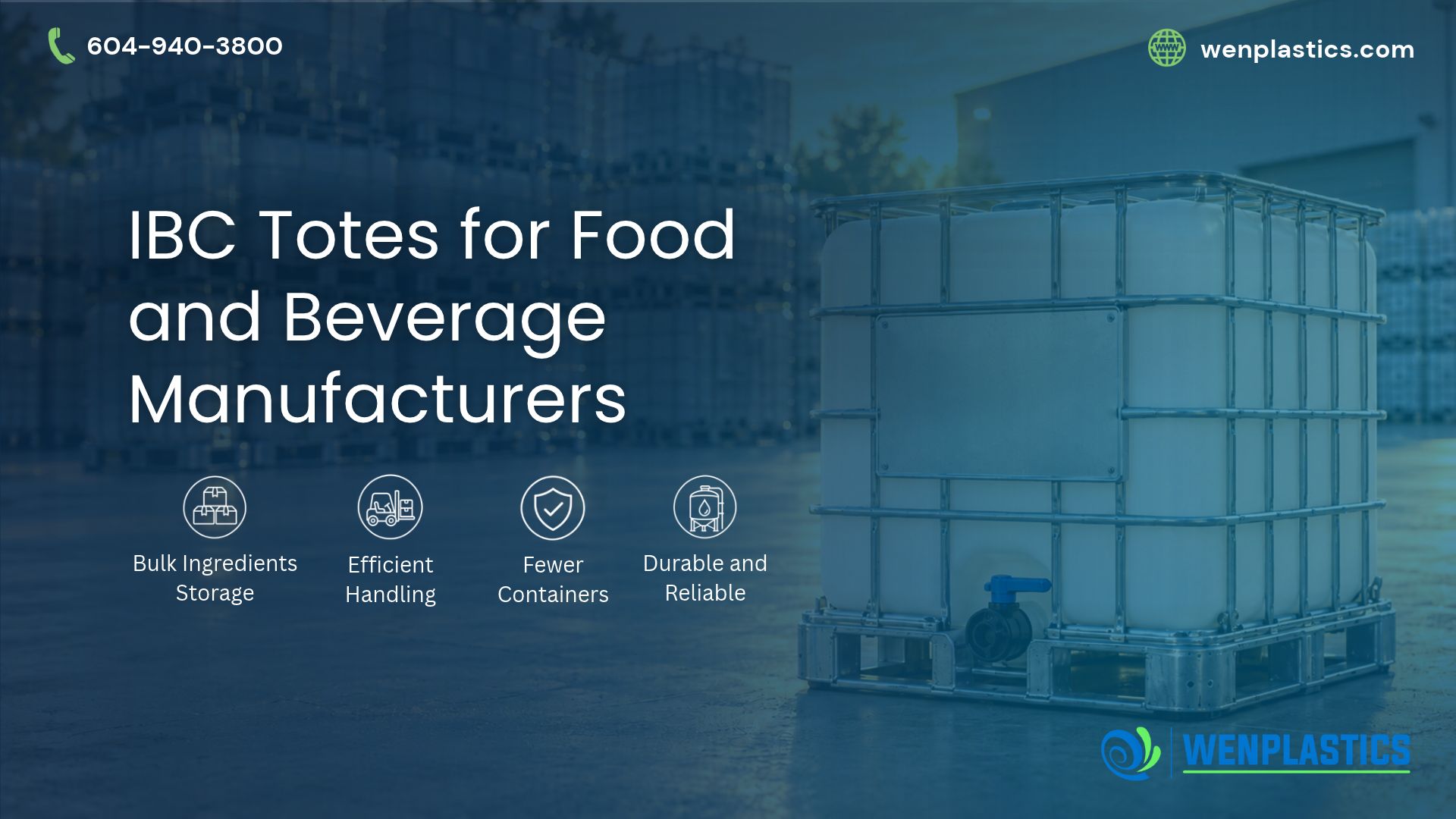
IBC Totes for Food and Beverage Manufacturers
Food and beverage manufacturers handle large quantities of liquid ingredients throughout their production processes. From receiving raw materials to storing ingredients and transporting finished products, choosing the right containers is essential for maintaining product quality, improving efficiency, and ensuring safe handling.
IBC totes (Intermediate Bulk Containers) provide a practical solution for storing and transporting bulk liquids. Their large capacity, durable construction, and convenient handling features make them a popular choice for food processing facilities, beverage manufacturers, and ingredient suppliers.
In this article, we explore how IBC totes are used in food and beverage manufacturing, their main benefits, and what businesses should consider when selecting containers for food-related applications.
Common Applications of IBC Totes in Food and Beverage Manufacturing
Food and beverage manufacturers use IBC totes to handle a wide range of liquid ingredients and products. Depending on the material compatibility, storage conditions, and food safety requirements, these containers can be used at different stages of production.
Some common applications include:
- Syrups and sweeteners: Bulk storage and transportation of maple syrup, corn syrup, liquid sugar, and other sweetening ingredients.
- Fruit juices and concentrates: Handling liquid fruit ingredients used in juice production and beverage manufacturing.
- Edible oils: Storing and transporting vegetable oils and other liquid cooking ingredients.
- Sauces and condiments: Managing bulk quantities of liquid sauces, dressings, and food preparations.
- Beverage ingredients: Handling liquid ingredients used in breweries, wineries, and other beverage production facilities.
IBC totes can also help manufacturers organize their ingredient inventory and move liquids between receiving, storage, and production areas.
Benefits of Using IBC Totes in Food and Beverage Production
1. Efficient Bulk Storage
One of the main advantages of IBC totes is their ability to store large volumes of liquid in a single container.
Compared to smaller containers, such as buckets or drums, IBC totes can reduce the number of individual units needed to manage the same quantity of liquid.
Common IBC tote capacities include:
- 275 gallons (approximately 1,000 litres)
- 330 gallons (approximately 1,250 litres)
Their rectangular design also makes efficient use of warehouse space, helping manufacturers organize bulk ingredients and optimize storage areas.
2. Easier Transportation and Handling
IBC totes are designed for handling with industrial equipment, including forklifts and pallet jacks.
Their integrated pallet bases allow workers to move large quantities of liquid throughout a facility without transferring the contents into multiple smaller containers.
Many IBC totes are also equipped with bottom discharge valves, making it easier to dispense liquids into compatible processing equipment or smaller containers.
These features can help simplify material handling and improve workflow efficiency in busy manufacturing environments.
3. Reduced Packaging and Handling Requirements
Using larger containers can reduce the number of individual packages required for bulk ingredients.
For example, a manufacturer receiving liquid ingredients in IBC totes may need to handle fewer containers than when receiving the same volume in smaller drums or pails.
This can help businesses:
- Reduce repetitive container handling.
- Simplify receiving and inventory management.
- Minimize the number of individual packaging units.
- Improve efficiency when transferring bulk liquids.
The actual benefits depend on production volumes, equipment configurations, and transportation requirements.
4. Durable Construction
Most composite IBC totes feature a high-density polyethylene (HDPE) inner bottle surrounded by a protective metal cage.
HDPE offers good resistance to many substances, while the external cage provides structural support during handling, storage, and transportation.
However, material compatibility should always be evaluated based on the specific liquid, concentration, temperature, and intended storage period.
Why Food-Grade IBC Totes Matter
When IBC totes are used for ingredients intended for human consumption, selecting containers suitable for food contact is particularly important.
Food-grade IBC totes are designed with materials appropriate for specified food-contact applications. The suitability of a container depends not only on its inner bottle but also on other components that may come into contact with the product, including valves, gaskets, and seals.
Manufacturers should consider several factors when choosing IBC totes for food and beverage applications:
- Material suitability: The inner bottle and other food-contact components must be appropriate for the product being stored.
- Previous contents: Containers used for direct food contact should have an acceptable and documented usage history, or a new inner bottle.
- Cleaning and sanitation: Appropriate procedures are necessary to prevent contamination during handling and reuse.
- Storage conditions: Temperature, light exposure, and storage duration can affect certain food and beverage products.
- Documentation: Businesses should verify applicable food-contact requirements and obtain supporting documentation where necessary.
In Canada, food manufacturers are responsible for ensuring that packaging materials are safe and suitable for their intended use. Canada+1
New vs. Rebottled IBC Totes for Food Applications
When purchasing IBC totes for food and beverage manufacturing, businesses may consider both brand-new and rebottled containers.
Understanding the difference can help manufacturers choose the most appropriate option for their needs.
Brand-New IBC Totes
Brand-new IBC totes are manufactured with a new HDPE inner bottle, a new external cage, and new components.
Because they have never been previously filled, they eliminate concerns about previous contents and are often preferred for applications requiring entirely new containers.
They are suitable for food and beverage operations when their materials and components meet the applicable food-contact requirements.
Rebottled IBC Totes
Rebottled IBC totes combine a brand-new HDPE inner bottle with a reconditioned metal cage.
This option provides a new interior container while reusing the external structure, making it an attractive alternative for businesses looking to balance product requirements, cost, and resource efficiency.
For food and beverage manufacturers, rebottled totes can be a practical solution because the inner bottle has not previously contained another product.
However, just like brand-new totes, the bottle, valve, seals, and other contact surfaces must be verified as suitable for the intended food application.
At Wenplastics, we offer both brand-new IBC totes and food-grade IBC tote options to help businesses find containers suited to their operational needs.
Choosing the Right IBC Tote for Your Manufacturing Process
Before purchasing IBC totes, food and beverage manufacturers should evaluate their operational requirements.
The type of liquid being stored is one of the most important considerations. Some products may require specific materials, handling procedures, or temperature controls to maintain their quality.
Manufacturers should also consider the quantity of liquid handled during production. Selecting the appropriate tote capacity can help improve storage efficiency and reduce unnecessary transfers between containers.
Another important consideration is the outlet valve. Choosing a valve configuration compatible with existing hoses, pumps, and processing equipment can simplify liquid dispensing and reduce handling difficulties.
Finally, businesses should assess their storage environment, transportation needs, and applicable food safety requirements before selecting a container.
IBC Totes for Food and Beverage Manufacturers in Canada
Choosing a reliable IBC tote supplier can help food and beverage manufacturers maintain consistent access to the containers they need for daily operations.
Wenplastics supplies IBC totes for a variety of industrial and commercial applications, including food and beverage manufacturing.
Our product options include brand-new and rebottled IBC totes in different capacities, allowing businesses to select containers based on their specific requirements.
Whether your company handles syrups, liquid ingredients, beverage concentrates, or other food-related products, our team can help you explore suitable IBC tote options.
Looking for IBC totes for your food or beverage manufacturing business?
Contact Wenplastics to discuss your application, required quantities, and container specifications. Our team can help you identify an appropriate solution for your storage and transportation needs.

No responses yet