
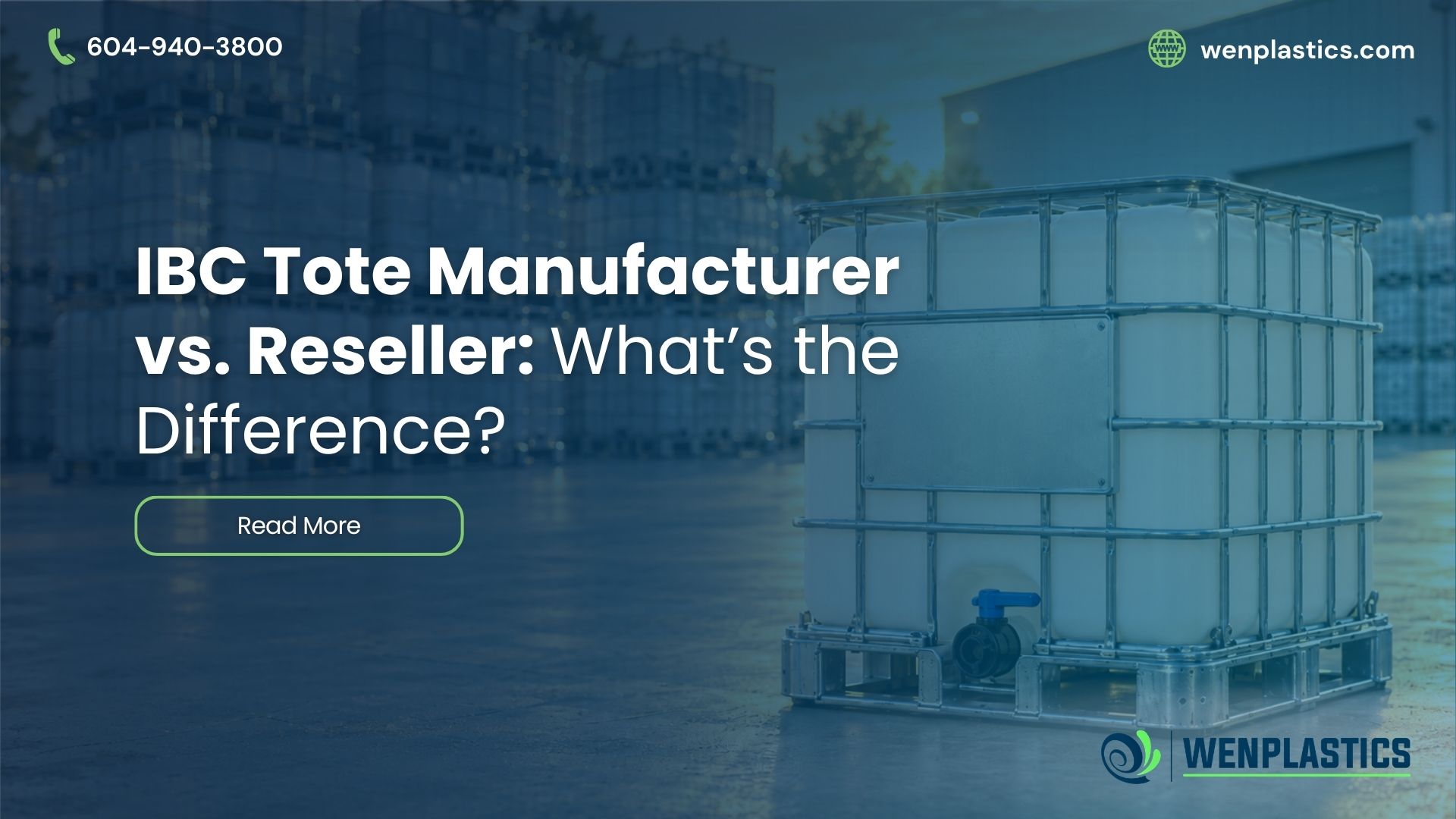
IBC Tote Manufacturer vs. Reseller: What’s the Difference?
When purchasing IBC totes for industrial, chemical, food-related, or manufacturing applications, one important question is often overlooked:
Are you buying from an IBC tote manufacturer or from a reseller?
At first glance, the difference may seem minor. After all, both can provide IBC totes. But the supplier you choose can affect product availability, customization, technical support, consistency, pricing, traceability, and long-term supply.
Understanding the difference can help businesses choose the right partner for their packaging needs.
What Is an IBC Tote Manufacturer?
An IBC tote manufacturer is directly involved in producing, assembling, refurbishing, or processing IBC components and finished containers.
Depending on the company, manufacturing operations may include:
- Producing HDPE inner bottles
- Assembling metal cages
- Installing valves and closures
- Manufacturing or sourcing pallet systems
- Rebottling used cages with new inner bottles
- Reconditioning reusable IBC totes
- Inspecting and testing containers
- Processing recovered plastic materials
- Managing industrial packaging recovery programs
Because manufacturers work directly with the product, they typically have more control over quality, specifications, production capacity, and product consistency.
What Is an IBC Tote Reseller?
An IBC tote reseller purchases containers from manufacturers or other suppliers and then sells them to customers.
Resellers usually do not manufacture the inner bottle, cage, or other major components themselves.
Instead, their role may focus on:
- Purchasing inventory
- Warehousing products
- Distributing IBC totes
- Serving local customers
- Coordinating transportation
- Offering different brands or product types
Resellers can be useful when customers need quick access to specific products or want to purchase from a local distributor.
However, the level of control over manufacturing, inventory, quality, and specifications may depend on the reseller’s own suppliers.
Manufacturer vs. Reseller: The Main Differences
The biggest differences usually come down to control, access, and technical knowledge.
1. Direct Access to the Product
When working with a manufacturer, the supplier is closer to the actual production process.
This can make it easier to understand:
- How the tote was produced
- What materials were used
- Which components are new or reused
- What inspection processes were followed
- What specifications are available
- Whether alternative configurations can be produced
A reseller may need to confirm this information with a third-party supplier.
For buyers with specific industrial requirements, direct access to the manufacturer can simplify the purchasing process.
2. Product Availability
Manufacturers may be able to maintain more consistent access to certain product lines because they control or directly manage production.
This can be especially important for businesses that purchase IBC totes regularly or in large quantities.
Instead of relying entirely on existing warehouse inventory, a manufacturer may be able to schedule production based on expected demand.
Resellers, on the other hand, may depend on stock purchased from other suppliers.
Availability can therefore change depending on upstream inventory and delivery schedules.
3. Greater Control Over Specifications
Not every customer needs the same IBC tote.
Some applications may require:
- A new inner bottle
- A specific valve
- A particular gasket material
- A certain pallet type
- Food-compatible components
- UN-rated configurations
- Specific capacity requirements
Manufacturers are often better positioned to provide information about these details because they work directly with the components and production process.
For customers with more technical applications, this can reduce uncertainty when selecting the right container.
4. Better Understanding of New, Rebottled, and Reconditioned IBC Totes
One of the most important distinctions when purchasing an IBC tote is understanding what type of container you are actually buying.
Brand-New IBC Tote
A brand-new IBC tote is made with new components, including the inner bottle, cage, pallet, valve, and closures.
Rebottled IBC Tote
A rebottled IBC tote combines a brand-new inner bottle with a suitable used cage and pallet.
This provides a new product-contact surface while allowing reusable structural components to remain in circulation.
Reconditioned IBC Tote
A reconditioned IBC tote generally uses an existing bottle, cage, and pallet that have gone through an appropriate cleaning and inspection process.
Manufacturers involved in rebottling or reconditioning typically have direct knowledge of these processes.
This can make it easier for customers to understand exactly what they are purchasing.
5. Quality Control and Inspection
Quality control is especially important in industrial packaging.
An IBC tote may be used to store or transport large quantities of liquid, so issues such as leaks, structural damage, valve failures, or contamination can create significant operational problems.
Manufacturers may perform inspections throughout production, assembly, refurbishment, or rebottling.
These checks may include:
- Bottle inspection
- Cage inspection
- Valve inspection
- Leak testing
- Component verification
- Structural evaluation
- Label and marking checks
A reseller may also perform quality checks, but in many cases, the original production and testing occurred before the product reached the reseller.
6. Technical Support
Customers often need more than just a price.
They may need help deciding:
- Which IBC is appropriate for the product being stored
- Whether a new bottle is required
- Which valve configuration is suitable
- Whether a tote is appropriate for food-related applications
- Whether a UN-rated container is required
- How to handle or store the tote properly
- Whether an existing IBC can be refurbished
A manufacturer that works directly with IBC totes every day may be able to provide more detailed technical guidance.
This can be especially valuable for industrial buyers, procurement teams, and companies changing packaging formats.
7. Large-Volume Orders
For customers purchasing large quantities of IBC totes, working directly with a manufacturer can offer advantages.
Manufacturers may be better positioned to support:
- Recurring orders
- Large production runs
- Scheduled supply
- Distributor programs
- Industrial contracts
- Long-term purchasing agreements
This can help businesses maintain a more predictable supply chain.
Resellers can also support volume orders, but their ability to do so may depend on availability from their own suppliers.
8. Pricing Structure
Buying directly from a manufacturer can sometimes reduce the number of steps between production and the final customer.
This may result in a more direct pricing structure, particularly for larger quantities.
However, price should not be the only factor when comparing suppliers.
Customers should also consider:
- Product condition
- Specifications
- Certification
- Delivery costs
- Availability
- Quality control
- Technical support
- Long-term reliability
A lower initial price may not provide better value if the product is not suitable for the intended application.
9. Traceability and Documentation
For some industries, understanding where packaging comes from is important.
Traceability can become especially relevant when dealing with:
- Dangerous goods
- Food-related applications
- Regulated products
- Repeat industrial orders
- Quality management systems
Manufacturers often maintain production, inspection, and batch-related information as part of their internal processes.
This can make it easier for customers to obtain documentation when required.
10. Recycling and End-of-Life Options
A manufacturer involved in both production and recycling may be able to support the entire lifecycle of an IBC tote.
Instead of simply selling a container, the supplier may also provide:
- Collection of used totes
- Inspection
- Refurbishment
- Rebottling
- Component recovery
- Plastic recycling
- Regrind production
This can help businesses reduce packaging waste and create more circular material flows.
For companies working toward sustainability or waste-reduction goals, this can be an important factor when choosing a supplier.
What’s better, a Manufacturer or a Reseller?
The right supplier depends on the customer’s needs.
A reseller may be a convenient choice when:
- Only a small quantity is required
- The product is already available locally
- Multiple brands need to be compared
- Immediate stock is the main priority
A manufacturer may be a better fit when:
- Large volumes are required
- Orders are recurring
- Technical specifications matter
- Product consistency is important
- Rebottled or reconditioned options are required
- Direct technical support is valuable
- Recycling or refurbishment services are needed
The important thing is understanding what type of supplier you are working with and what level of control they have over the product.
Questions to Ask Before Choosing an IBC Tote Supplier
Before placing an order, businesses may want to ask:
- Are you the manufacturer or a reseller?
- Do you manufacture or rebottle IBC totes in-house?
- Are your inner bottles new or previously used?
- What inspection process do you follow?
- Do you offer brand-new, rebottled, and reconditioned options?
- Can you support recurring or high-volume orders?
- Do you provide UN-rated IBC totes?
- Can you provide technical specifications?
- Do you offer recycling or refurbishment services?
- Where are the totes produced or processed?
These questions can make it easier to compare suppliers based on more than price alone.
Working Directly With an IBC Tote Manufacturer
For businesses that rely on IBC totes as part of their operations, working directly with a manufacturer can provide greater visibility into the product, its components, and the processes behind it.
This can be particularly useful for companies that need consistent supply, technical support, large-volume purchasing, or different IBC configurations.
The relationship becomes less about purchasing a single container and more about building a reliable industrial packaging supply chain.
IBC Tote Manufacturing and Recycling at Wenplastics
Wenplastics provides industrial packaging solutions including brand-new, rebottled, and reconditioned IBC totes, as well as refurbishment and plastic recovery services.
By working directly with IBC components, recovered materials, and industrial packaging processes, Wenplastics helps businesses find solutions based on their application, volume, and operational requirements.
Whether you need a regular supply of IBC totes, a new inner bottle, or a recycling solution for used industrial packaging, contact Wenplastics to discuss your requirements.

Comments are closed