
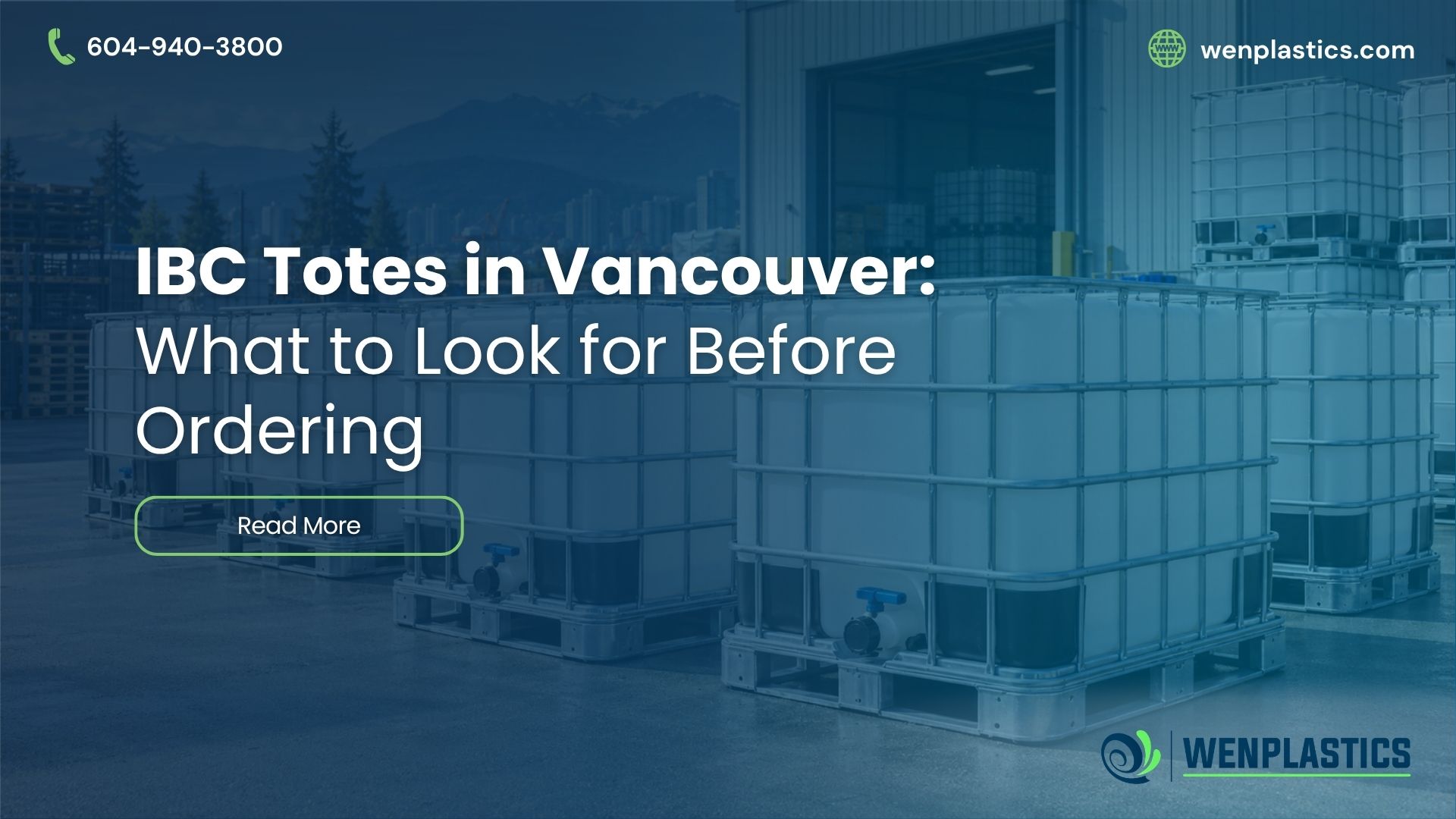
IBC Totes in Vancouver: What to Look for Before Ordering
IBC totes are widely used across Metro Vancouver for storing and transporting liquids in industries such as manufacturing, food processing, agriculture, chemicals, construction, and recycling.
But not every IBC tote is the same.
Before ordering, businesses should consider the condition of the tote, bottle type, capacity, certification, previous use, valve configuration, pickup or delivery requirements, and supplier reliability.
Taking a few minutes to confirm these details can help prevent compatibility issues, unexpected costs, and delays.
1. Decide Between New, Rebottled, and Reconditioned IBC Totes
One of the first things to determine is what type of IBC tote your application requires.
Brand-New IBC Totes
A brand-new IBC tote uses new components, including the inner bottle, cage, pallet, valve, and closures.
New totes may be appropriate when customers require entirely new packaging or have applications with stricter product-contact requirements.
Rebottled IBC Totes
A rebottled IBC combines a brand-new inner bottle with a suitable used cage and pallet.
This provides a new product-contact surface while allowing reusable structural components to remain in circulation.
For many businesses, rebottled totes provide a practical balance between product requirements and material reuse.
Reconditioned IBC Totes
A reconditioned IBC tote generally retains the existing bottle, cage, and pallet after going through appropriate cleaning and inspection processes.
These totes can work well for many industrial applications where a new inner bottle is not required.
Before ordering, make sure you understand exactly which type of tote the supplier is offering.
2. Consider What You Will Put Inside the Tote
The contents of the IBC should influence your purchasing decision.
Ask yourself:
- Is the product a food ingredient?
- Is it a chemical?
- Is it hazardous or regulated?
- Is it water or another relatively neutral liquid?
- Could the material react with the bottle, valve, or gasket?
Chemical compatibility is particularly important.
The inner bottle is commonly made from HDPE, but the valve, gasket, and other components can vary.
A tote that works well for one product may not necessarily be appropriate for another.
3. Know the Previous Use of a Used IBC
If you are considering a reconditioned IBC tote, previous contents matter.
A tote should not automatically be reused for a new application simply because it looks clean.
For sensitive applications, a rebottled IBC with a new inner bottle may be a more suitable option because the product-contact surface is new.
When talking to a supplier, explain the intended application rather than simply asking for the least expensive tote available.
4. Choose the Right Capacity
Two of the most common IBC sizes are approximately:
- 275 gallons / 1,000 litres
- 330 gallons / 1,200 litres
The larger tote provides additional capacity, but capacity is not the only consideration.
You should also think about:
- Available warehouse space
- Filling equipment
- Transportation requirements
- Product consumption
- Weight when filled
- Handling equipment
- Pallet and rack dimensions
For businesses ordering multiple totes, even small dimensional differences can affect warehouse layout and transportation efficiency.
5. Check the Valve Configuration
The outlet valve is one of the most important components of an IBC tote.
Before placing an order, confirm that the valve works with your existing equipment.
Consider:
- Valve size
- Connection type
- Outlet thread
- Gasket material
- Adapter requirements
Finding out after delivery that your existing hose or pump cannot connect to the tote can create unnecessary downtime.
If you are uncertain, ask the supplier for the valve specifications before ordering.
6. Determine Whether You Need a UN-Rated IBC Tote
If the tote will be used to transport certain dangerous goods, standard industrial packaging may not be sufficient.
You may require a properly certified UN-rated IBC tote.
UN-marked composite IBCs can carry markings such as 31HA1, along with additional information related to the design type, testing, manufacture, and permitted use.
The important point is that not every IBC tote is automatically suitable for dangerous goods transportation.
If your product is regulated, tell the supplier what the tote will be used for and verify the required certification before purchasing.
7. Inspect the Bottle, Cage, and Pallet
For rebottled and reconditioned totes, structural condition matters.
An IBC consists of several major components:
- HDPE inner bottle
- Steel cage
- Pallet or base
- Valve and closures
When evaluating a tote, look for potential issues such as:
- Significant cage deformation
- Corrosion
- Pallet damage
- Cracks or deformation in the bottle
- Damaged valves
- Missing closures
- Evidence of leakage
For industrial use, the tote needs to be more than visually acceptable. Its structural components must also remain suitable for handling the filled load.
8. Ask What Type of Pallet the Tote Uses
IBC totes can be manufactured with different pallet systems.
The pallet affects how the tote is:
- Moved by forklift
- Stored
- Stacked
- Transported
- Supported when filled
If your facility already uses specific handling equipment, confirm that the pallet design is compatible.
For Wenplastics IBC visuals and product configurations, steel pallet systems are an important part of the standard presentation.
9. Think About Pickup and Transportation Before Ordering
An empty 1,000- or 1,200-litre IBC tote is still a large piece of industrial packaging.
Before ordering, determine:
- Will you pick it up?
- Do you require delivery?
- How many totes will fit on your vehicle?
- Can the receiving location accommodate a truck?
- Do you have a forklift or appropriate unloading equipment?
Transportation costs can become significant when buying only a few totes, so it is worth considering logistics before comparing suppliers based solely on unit price.
For businesses in Vancouver, Richmond, Burnaby, Surrey, Langley, and the surrounding region, purchasing from a Metro Vancouver-area supplier can also simplify pickup and replenishment.
10. Ask About Quantity Pricing
IBC tote pricing may vary based on:
- Tote type
- Quantity
- Capacity
- Certification
- Configuration
- Availability
- Transportation requirements
If your business uses IBC totes regularly, tell the supplier your approximate ongoing volume.
A recurring requirement may be handled differently from a one-time purchase of one or two totes.
Instead of asking only:
“How much is an IBC tote?”
It is more useful to provide:
Type + quantity + application + pickup/delivery location.
That gives the supplier enough information to provide a more accurate quote.
11. Consider Supply Consistency
Price matters, but so does availability.
If IBC totes are part of your regular operations, running out of packaging can interrupt production or shipping.
Ask potential suppliers:
- Do you keep inventory locally?
- Can you support recurring orders?
- Do you manufacture or process the totes themselves?
- Can they support larger quantities?
- How quickly can they replenish inventory?
For repeat buyers, a reliable supply relationship may be more valuable than saving a small amount on an individual tote.
12. Know Whether You Are Buying From a Manufacturer or Reseller
Some IBC suppliers manufacture, rebottle, recondition, or process the containers themselves.
Others purchase finished inventory from another supplier and resell it.
Both models can work, but there are differences.
Working directly with a manufacturer may provide better visibility into:
- Product specifications
- Available configurations
- Manufacturing or refurbishment processes
- Quality control
- Volume supply
- Technical questions
Before ordering, it is worth understanding how much control your supplier has over the product they are selling.
13. Consider What Happens to the Tote After Use
IBC totes can often remain valuable even after their original application has ended.
Depending on their condition, they may be:
- Reused
- Reconditioned
- Rebottled
- Refurbished
- Dismantled for material recovery
- Recycled
Businesses that regularly use industrial packaging may benefit from working with a supplier that can support both new packaging requirements and end-of-life recovery.
This can simplify waste management while keeping usable materials in circulation.
Questions to Ask an IBC Tote Supplier Before Ordering
Before you place an order, confirm:
- Is the tote new, rebottled, or reconditioned?
- What capacity is it?
- What type of valve does it have?
- What pallet system is used?
- Is the tote suitable for my product?
- Is UN certification required for my application?
- What quantity is available?
- Is there volume pricing?
- Is pickup available?
- Can transportation be arranged?
- Do you offer refurbishment or recycling services?
Getting these answers upfront makes it much easier to compare suppliers accurately.
Buying IBC Totes in the Vancouver Area
For Metro Vancouver businesses, proximity to the supplier can make industrial packaging procurement easier.
Wenplastics manufactures and supplies industrial packaging from Delta, British Columbia, serving businesses looking for brand-new, rebottled, and reconditioned IBC totes, as well as refurbishment and plastic recovery solutions.
Whether you need a single tote or an ongoing supply, choosing the right option starts with understanding your application.
When requesting a quote, provide your preferred IBC type, quantity, intended use, and pickup or delivery requirements so the supplier can recommend the most suitable option.

No responses yet