
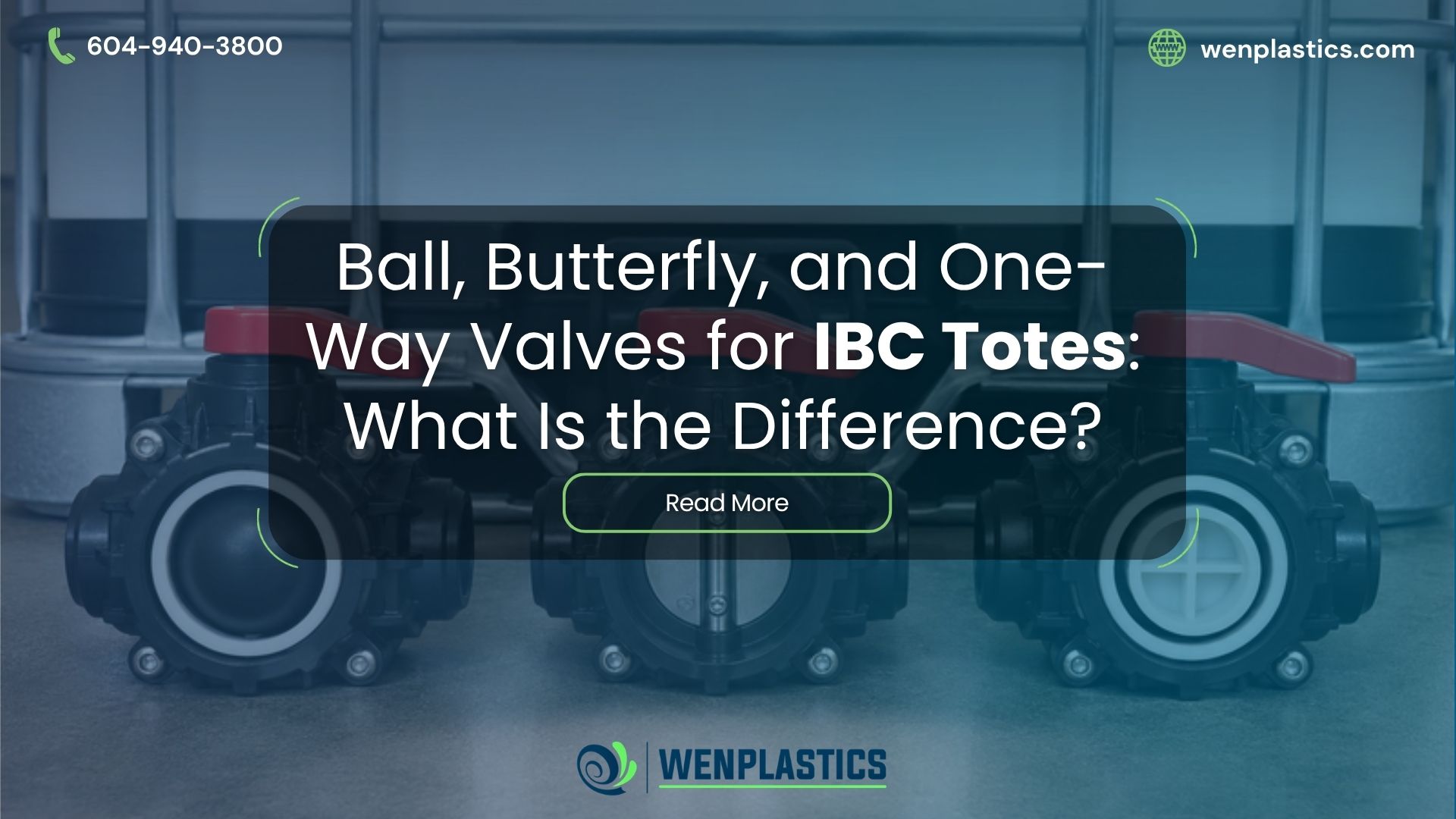
Ball, Butterfly, and One-Way Valves for IBC Totes: What Is the Difference?
IBC totes are widely used for storing, transporting, and dispensing liquids across different industries, including food and beverage, agriculture, chemicals, cleaning products, manufacturing, and recycling.
When choosing an IBC tote, many businesses focus on the bottle, cage, pallet, or capacity. However, the valve is also an important part of the container. The valve affects how the product is discharged, how easily it connects to hoses or pumps, and how well the system supports safe and efficient handling.
Three valve types that may be used with IBC totes or IBC tote systems are butterfly valves, ball valves, and one-way valves. Each one has a different purpose, and choosing the right option depends on the product, the application, and how the tote will be used.
What Is an IBC Tote Valve?
An IBC tote valve is the outlet component usually located at the bottom of the tote. It allows the product inside the container to be drained, dispensed, transferred, or connected to hoses and equipment.
Most standard IBC totes are equipped with a bottom discharge valve, commonly in a 2-inch size, although other valve sizes and outlet connections may be available depending on the tote design.
The most common outlet valves are usually butterfly valves or ball valves. In some systems, a one-way valve may also be added to help control the direction of flow and prevent liquid from moving backward.
Before choosing a valve, businesses should consider the product type, viscosity, chemical compatibility, food-grade requirements, gasket material, outlet size, and connection type.
What Is a Butterfly Valve?
A butterfly valve uses a flat internal disc to open and close the flow path. When the handle is turned, the disc rotates inside the valve body. In the closed position, the disc blocks the flow. In the open position, the disc turns and allows the liquid to pass through.
Butterfly valves are very common on IBC totes because they are simple, practical, and cost-effective. They are often used for standard liquid applications where the product flows easily and does not require highly precise flow control.
When to Use a Butterfly Valve
A butterfly valve is often a good option for low to medium viscosity liquids. It is commonly used when the main goal is simple discharge from the tote.
Butterfly valves may be suitable for products such as:
- Water-based products
- Cleaning solutions
- Liquid fertilizers
- Some agricultural products
- Some chemicals
- Light oils
- Low-viscosity food ingredients, when the tote and valve are suitable for food-grade use
Butterfly valves are often preferred when the product is easy to drain by gravity or when the tote will be connected to basic dispensing equipment.
Benefits of Butterfly Valves
One of the main benefits of a butterfly valve is its simple operation. The handle can usually be opened or closed with a quarter turn, making it easy for workers to use during daily operations.
Butterfly valves are also commonly available, which can make replacement parts, caps, and adapters easier to source. For many businesses, this makes them a practical choice for regular IBC tote use.
Another advantage is cost. Butterfly valves are generally an economical option for many standard applications.
Limitations of Butterfly Valves
Although butterfly valves work well for many products, they may not be ideal for every application.
Because the internal disc remains inside the flow path, it can create some flow restriction. This may matter when working with thicker liquids, sticky products, or products that contain suspended particles.
Butterfly valves may also be less suitable when the application requires a tighter shutoff or more controlled discharge. In these cases, a ball valve may be a better option.
What Is a Ball Valve?
A ball valve uses a round internal ball with a hole through the center. When the handle is turned, the ball rotates. In the open position, the hole lines up with the flow path and allows liquid to pass through. In the closed position, the solid side of the ball blocks the flow.
Ball valves are known for strong shutoff and reliable flow control. They are often used when the product is thicker, when a tighter seal is needed, or when the application requires more controlled handling.
When to Use a Ball Valve
A ball valve may be a better option for products that are more viscous, dense, sticky, or harder to discharge.
Ball valves may be suitable for products such as:
- Oils
- Syrups
- Sauces
- Resins
- Detergents
- Some chemicals
- Products with small particles
- Products that require tighter shutoff
For businesses that need a more secure closure or better control during discharge, a ball valve can be a practical option.
Benefits of Ball Valves
One of the main advantages of a ball valve is its sealing performance. Ball valves are often selected when the product requires a tighter shutoff or when the risk of leakage needs to be reduced.
Ball valves can also provide a more open flow path when fully open, depending on the valve design. This may help with thicker products or materials that need smoother discharge.
Another benefit is durability. Ball valves are often used in applications where reliable opening and closing performance is important.
Limitations of Ball Valves
Ball valves can be more expensive than butterfly valves, depending on the design, size, and material.
They may also require more attention when it comes to cleaning, especially in food, beverage, or sensitive applications. Some valve designs can retain small amounts of product around the internal ball area, so it is important to consider sanitation and product compatibility.
For simple, low-viscosity liquids, a ball valve may not always be necessary. In many standard applications, a butterfly valve can perform well while offering a more economical solution.
What Is a One-Way Valve?
A one-way valve is also known as a check valve or non-return valve. Unlike a butterfly valve or ball valve, its main purpose is not simply to manually open or close the tote outlet.
A one-way valve is designed to allow liquid to flow in only one direction. If the liquid tries to flow backward, the valve automatically closes and helps prevent backflow.
This type of valve is often used as part of a transfer system, hose connection, pump setup, or production line. It can help protect equipment, reduce the risk of reverse flow, and support better control during liquid handling.
When to Use a One-Way Valve
A one-way valve may be useful when liquid is being pumped or transferred from an IBC tote into another system and the business needs to prevent the liquid from flowing backward.
One-way valves may be used in situations such as:
- Pumping liquid from an IBC tote into a production line
- Transferring product through hoses
- Preventing liquid from returning to the tote
- Reducing the risk of cross-contamination
- Protecting pumps and equipment from reverse flow
- Keeping liquid moving in one controlled direction
This can be especially important for food ingredients, chemicals, cleaning products, fertilizers, oils, and other liquids where backflow could create quality, safety, or equipment concerns.
Benefits of One-Way Valves
The main benefit of a one-way valve is backflow prevention. It helps make sure the product moves in the intended direction and does not return into the tote, hose, pump, or processing system.
This can help protect product quality, especially when different materials are being handled in the same facility. It may also help protect pumps and other equipment from damage caused by reverse flow.
Another benefit is that one-way valves work automatically. Once installed correctly, they respond to the flow direction without requiring manual opening and closing during normal operation.
Limitations of One-Way Valves
A one-way valve is not usually a replacement for a standard IBC tote outlet valve. It does not serve the same purpose as a butterfly valve or ball valve.
Instead, it is normally used as an additional component in the transfer system. A tote may still need a butterfly valve or ball valve at the outlet, while the one-way valve is added to the hose, pump, or connection line.
One-way valves also need to be selected carefully. The valve must be compatible with the product, flow rate, pressure, viscosity, and cleaning requirements of the application.
Ball Valve vs. Butterfly Valve vs. One-Way Valve
The main difference between these valves is their function.
A butterfly valve is commonly used as a standard manual outlet valve for simple discharge.
A ball valve is also used as a manual outlet valve, but it may offer tighter shutoff and better performance for thicker products.
A one-way valve is used to control the direction of flow and prevent liquid from flowing backward.
| Valve Type | Main Function | Best Used For |
| Butterfly valve | Opens and closes the tote outlet | Standard liquid discharge |
| Ball valve | Opens and closes the tote outlet with tighter shutoff | Thicker liquids or applications needing stronger sealing |
| One-way valve | Allows flow in one direction and prevents backflow | Pumping, transfer lines, and backflow prevention |
How to Choose the Right Valve for Your IBC Tote
Choosing the right valve depends on how the tote will be used. Before selecting a valve, businesses should consider the product, the equipment, and the handling process.
Product viscosity
Thin liquids usually discharge easily through a butterfly valve. Thicker products may require a ball valve for smoother flow and better shutoff.
Backflow risk
If liquid is being pumped through a hose or production line, a one-way valve may be useful to prevent the product from flowing backward.
Food-grade requirements
For food and beverage applications, the tote, valve, gasket, and fittings must be suitable for food contact. If the previous contents of a reconditioned tote cannot be confirmed, a new or rebottled food-grade IBC tote is usually the safer recommendation.
Chemical compatibility
The valve and gasket material must be compatible with the product. Some chemicals, oils, and cleaning products may require specific materials to avoid damage, leaks, or contamination.
Connection type
Different IBC totes may have different valve threads, outlet sizes, caps, and adapters. It is important to confirm that the valve will connect properly to the hose, pump, or dispensing equipment used in your facility.
Cleaning and maintenance
Some applications require easier cleaning than others. Food, beverage, cosmetic, and sensitive chemical applications may need special attention to residue, valve design, and sanitation procedures.
Which Valve Is Best for Your Application?
There is no single valve that is best for every IBC tote application.
A butterfly valve is often a practical choice for standard liquids and general discharge.
A ball valve may be better for thicker products, tighter shutoff, or more demanding handling needs.
A one-way valve may be needed when the product is being pumped or transferred and the system must prevent reverse flow.
In many cases, these valves can also work together. For example, an IBC tote may have a butterfly or ball valve at the outlet, while a one-way valve is added to the hose or transfer system to prevent backflow.
IBC Tote Solutions from Wenplastics
At Wenplastics, we provide IBC tote solutions for a wide range of industries, including food and beverage, agriculture, chemicals, manufacturing, cleaning products, and recycling.
Whether your business needs brand-new, rebottled, or reconditioned IBC totes, choosing the right valve is an important part of making sure the tote works properly for your application.
Our team can help you review your product type, handling process, and valve requirements so you can choose the right IBC tote solution for your business.
Contact Wenplastics to learn more about available IBC tote options, valve configurations, and packaging solutions.

Comments are closed